
The Ritual Home: How Thoughtful Architecture Shapes Daily Habits and Human Flourishing
There is a quiet intelligence to the homes that make us feel most ourselves. A room where the ceiling rises just enough to let the mind expand. A window that catches the morning light at precisely the right angle to make the first coffee feel like an occasion. These are not accidents of taste. They are the result of design that understands something fundamental: that space does not merely contain life; it shapes it.
The Space That Shapes You
Environmental psychology has accumulated decades of evidence showing that our surroundings influence mood, cognition, and habitual behavior in measurable ways. The built environment is not a neutral container; it is an active participant in how we think, rest, and recover. Natural light regulates cortisol and melatonin. The presence of organic material (wood, stone, greenery) reduces physiological stress markers in ways that synthetic surfaces do not. This is the terrain of biophilic design: a framework built on the deep evolutionary relationship between human beings and the natural world. A CLT home is an inherently biophilic environment; not as a stylistic gesture, but as a structural condition.
Proportions, Sequence, and the Way We Move
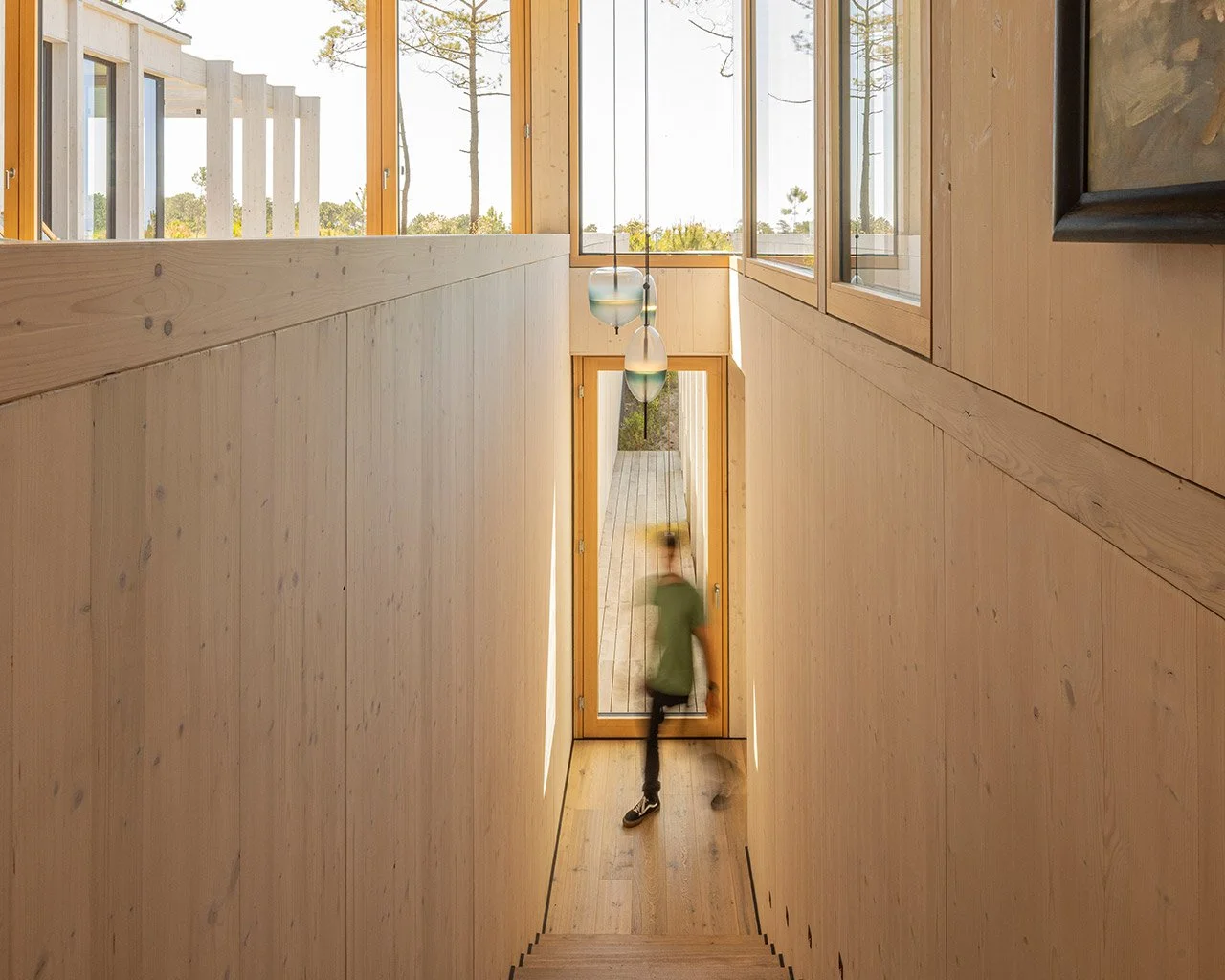
The way a home unfolds spatially governs the rhythms of a day. Research affiliated with the Academy of Neuroscience for Architecture has demonstrated that human beings read spatial transitions instinctively, orienting their emotional state in response to changes in scale and proportion. Every meaningful ritual begins with a threshold: the front door, the entrance hall, the passage from kitchen to terrace. In a well-designed home, that transition is architecturally supported: a compression of space, a change of material underfoot, a shift in light. These are the small ceremonies of daily life.
What the Hand Knows: Material Texture and the Tactile Sense
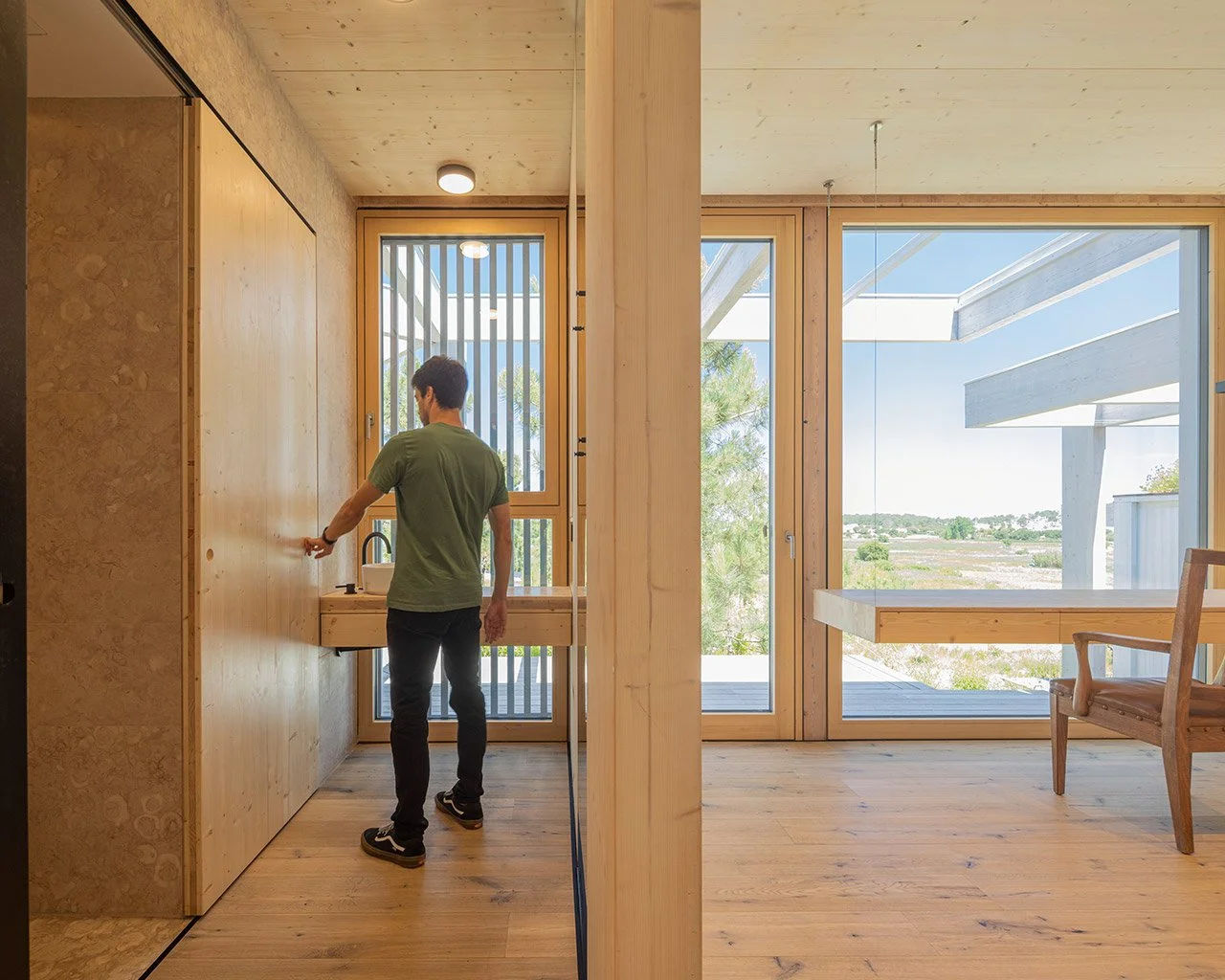
Touch is the oldest sense. Natural wood surfaces (larch cladding, spruce panels, walnut underfoot) engage the tactile sense in ways that no synthetic material replicates. Research from the Karolinska Institute has observed that contact with natural wood produces a measurable reduction in sympathetic nervous system activation: a physiological calming that registers in the body before the mind notices. In a CLT home, this is not a feature added to a room; it is the room. The material that bears the load is the same material you run your hand along each morning.
Light as Architecture
Light in a CLT home behaves differently. The warm undertone of timber reflects and diffuses natural light, so the quality of the day (soft and grey, or sharp and golden) remains legible in the interior. Research on circadian biology confirms that exposure to natural light variation supports healthy sleep, stable mood, and consistent energy. In an Arolla home, the central shared space changes character through the hours, offering a different quality of attention at nine in the morning than at four in the afternoon. Generations find their own relationship with the same shared light.
Acoustic Intimacy: The Sound of a Good Life
Acoustic comfort matters equally. The Design Council UK has identified chronic low-level noise as a significant and underestimated residential stressor. CLT's mass and density absorb mid-frequency sound more effectively than lighter structures, producing a quality of quiet that feels inhabited: where conversations do not bleed between rooms, where rain on a larch-clad roof has texture rather than intrusion. Across European markets, demand for homes delivering measurable wellbeing outcomes continues to rise.
Building for the Rituals That Matter
A good home does not merely accommodate life; it creates the conditions for life to become more fully itself.At Arolla, every home is conceived as an intergenerational environment: spaces designed to adapt as families grow and needs evolve across decades. The materials (Arolla pine, spruce, larch, chestnut, walnut) are chosen not only for their structural qualities, but for their capacity to age with grace. A home built this way is not a product. It is a commitment: to the people who will inhabit it, to the forest that gave its timber, and to the generations that follow. That commitment is what distinguishes a house from a home and what makes the architecture of daily ritual worth getting right.